


14
40
3+
Prepare to embark on an extraordinary journey through the timeless land of pharaohs and pyramids with our meticulously crafted 14-day Egyptian odyssey. This once-in-a- lifetime adventure weaves together the golden threads of ancient history, breathtaking natural landscapes, vibrant cultural encounters, and unparalleled luxury experiences. From the awe-inspiring monuments of Cairo and Giza to the serene waters of the Nile, from the magnificent temples of Luxor to the crystal-clear shores of the Red Sea, every moment of this private tour has been thoughtfully designed to create memories that will resonate through your life for years to come. Accompanied by expert Egyptologist guides and cradled in 5-star comfort throughout, you’ll discover the many faces of Egypt in a journey that balances profound historical exploration with authentic cultural immersion and rejuvenating leisure.
Your Egyptian adventure begins the moment your plane touches down at Cairo
International Airport. As you emerge from the aircraft, you'll be greeted by our VIP
airport assistant who will whisk you through the immigration process with ease,
bypassing the usual queues and formalities. This seamless welcome sets the tone for the
luxury experience that awaits throughout your journey.
Outside the terminal, your private chauffeur stands ready beside a comfortable, air-
conditioned vehicle adorned with fresh flowers and stocked with cool towels and
refreshing beverages. As you glide through Cairo's vibrant streets, your guide will offer
fascinating insights into this city where ancient history and modern life intertwine in a
captivating dance.
Your destination is the legendary Marriott Mena House, a historic property that once
hosted royalty and celebrities, now transformed into a luxury hotel that maintains its
old-world charm. As you check in, you'll be captivated by the hotel's stunning
architecture, lush gardens, and most impressively, the breathtaking views of the Great
Pyramids of Giza rising majestically in the near distance – a tantalizing preview of
tomorrow's adventures.
After settling into your elegantly appointed room, take time to refresh and perhaps
explore the hotel's beautiful grounds or enjoy a dip in the pool with the pyramids as your
backdrop. As evening falls, you'll be escorted to Sequoia, one of Cairo's most
sophisticated restaurants perched on the banks of the mighty Nile. Here, under the
gentle glow of lanterns with the river flowing peacefully by, you'll savor your first taste of
contemporary Egyptian cuisine – perhaps starting with creamy hummus and freshly
baked bread, followed by succulent grilled meats or the catch of the day. Over a
welcome drink, your guide will brief you on the exciting journey ahead, answering any
questions and ensuring you're perfectly prepared for the wonders that await.
Awaken to the golden Egyptian sunrise and enjoy a sumptuous breakfast on the terrace,
the pyramids glowing in the morning light before you. Today marks your first full day of
exploration, and what better way to begin than with humanity's most enduring
architectural achievements?
Your private Egyptologist guide will meet you in the lobby, ready to transport you across
millennia to the age of pharaohs. Just a short drive brings you to the Giza Plateau, where
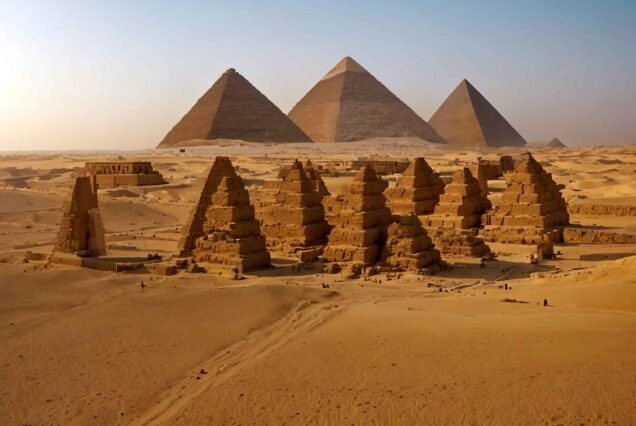
you'll stand in awe before the Great Pyramid of Khufu, the oldest and largest of the
Seven Wonders of the Ancient World. As you walk around its massive base, your guide
will reveal the ingenious methods used to construct this 481-foot monument over 4,500
years ago, with blocks weighing up to 80 tons fitted with astonishing precision.
Nearby stands the slightly smaller Pyramid of Khafre, distinctive for the limestone casing
stones that still cap its peak, and the Pyramid of Menkaure, the smallest of the three
main pyramids. Throughout your exploration, your guide will bring these ancient
structures to life with stories of the pharaohs who commissioned them and the skilled
workers who built them, not as slaves as popularly believed, but as honored craftsmen.
A short walk brings you face-to-face with the enigmatic Great Sphinx, its human head
and lion's body carved from a single massive limestone ridge. As you gaze into its
weathered face, ponder the mysteries that still surround this guardian of the pyramids –
who ordered its construction? What did it originally look like with its now-missing nose
and ceremonial beard? Your guide will share the latest archaeological theories and the
fascinating legends that have accumulated around this iconic monument over
thousands of years.
Your morning continues at the Solar Boat Museum, housing a full-sized, reconstructed
cedar vessel discovered buried beside the Great Pyramid – a ship meant to carry the
pharaoh through the heavens in his afterlife journey. The preservation and reassembly
of this 4,500-year-old boat represents one of archaeology's greatest achievements.
No visit to the pyramids would be complete without experiencing the desert as the
ancients did. Mounting gentle, well-trained camels, you'll embark on a memorable ride
across the sands, feeling the rhythm of these "ships of the desert" as you take in
panoramic views of all three pyramids aligned majestically against the horizon – a
perspective that few visitors experience and a perfect photo opportunity.
After working up an appetite, you'll head to the beloved local institution Abou Tarek,
where you'll sample Egypt's national dish, koshari – a delicious, hearty mixture of rice,
lentils, chickpeas, pasta, and crispy onions topped with a spiced tomato sauce. This
humble yet satisfying meal offers a taste of authentic Egyptian street food in a clean,
welcoming environment.
In the afternoon, your journey continues to Saqqara, home to the revolutionary Step
Pyramid of Djoser. Built around 2630 BCE, this architectural marvel represents the
world's first large-scale stone monument and the crucial evolutionary step between
simple mastaba tombs and true pyramids. Your guide will lead you through the recently
opened Saqqara complex, including the magnificent tomb of Mehu with its vivid wall
paintings depicting daily life in ancient Egypt.
As the day cools into evening, return to the Giza Plateau for the dramatic Sound and
Light Show. Seated under the desert stars, you'll watch as the monuments are
illuminated in changing colors while a narrated story unfolds, telling tales of pharaohs
and gods in the very shadow of their creations. This multisensory experience provides a
fitting conclusion to your day of archaeological wonders before returning to your hotel
for a well-earned rest.
After a leisurely breakfast, today's adventure takes you into the heart of Islamic Cairo,
where magnificent mosques, bustling markets, and medieval architecture create an
atmosphere straight from the pages of "One Thousand and One Nights."
Your first destination is the imposing Citadel of Saladin, a medieval fortress perched on a
hill overlooking the city. Built in the 12th century to protect against Crusader attacks,
this massive complex offers spectacular panoramic views across Cairo, with the
pyramids visible on the horizon on clear days. Within the citadel walls stands the
magnificent Mohamed Ali Mosque, often called the Alabaster Mosque for its gleaming
white exterior. As you step inside, removing your shoes as is customary, you'll be struck
by the vast main prayer hall with its central dome, hanging chandeliers, and intricate
Ottoman design. Your guide will explain the mosque's historical significance and
architectural features while giving insights into Islamic religious practices.
From here, you'll continue to Al-Azhar Mosque, one of the world's oldest continuously
functioning universities and a center of Islamic learning since 970 CE. The mosque's
elegant minarets and spacious courtyard exemplify classical Islamic architecture, while
its role as an educational institution has earned it the nickname "the luminous" for
spreading knowledge throughout the Muslim world. As you explore its peaceful interior,
your guide will share stories of the scholars who studied here and the intellectual
traditions they established.
For lunch, you might sample traditional Egyptian fare at a local restaurant, perhaps
trying specialties like molokhia (a nutritious green soup) or hamam mahshi (stuffed
pigeon), before continuing your cultural immersion.
The afternoon brings you to Khan El-Khalili, Cairo's most famous bazaar and a trading
center since the 14th century. Here, narrow, winding alleys open into small squares filled
with shops selling everything from intricate gold jewelry and hand-blown glass to
aromatic spices and handcrafted copper items. The air is perfumed with incense and
mint tea as you wander through this medieval marketplace where haggling is not just
expected but an essential part of the experience.
Your guide will help you navigate the labyrinthine passages, pointing out workshops
where artisans practice centuries-old crafts and suggesting quality souvenirs that
support local craftspeople. Take time to observe the social heart of the bazaar, where
Cairenes gather to smoke shisha (water pipes) and discuss the day's events in traditional
ahwas (coffeehouses).
As evening approaches, you'll dine at the atmospheric Naguib Mahfouz Restaurant,
named after Egypt's Nobel Prize-winning author. Nestled in the heart of the bazaar, this
elegant eatery serves refined Egyptian cuisine in a setting that evokes the Cairo of the
1930s, with mashrabiya screens, brass lanterns, and traditional music. Over a feast of
mezze (small plates) and classic Egyptian main courses, you might reflect on the day's
experiences and the layers of history you've encountered in this fascinating city.
This morning, after enjoying breakfast at your hotel, your exploration takes you to yet
another facet of Egypt's rich cultural tapestry – Coptic Cairo, the historic center of
Egypt's Christian community. This atmospheric district contains some of the world's
oldest Christian churches and represents a living link to Egypt's pre-Islamic past.
Your first stop is the Hanging Church (Al-Mu'allaqah), built atop the gatehouse of the
Roman fortress of Babylon. Named for its location suspended above ground level, this
9th-century church features beautiful wooden ceilings designed to resemble Noah's Ark,
intricate ivory-inlaid screens, and 13 pillars representing Jesus and his disciples. The
peaceful interior, illuminated by delicate chandeliers, creates a contemplative
atmosphere where Coptic Christians have worshipped for over a millennium.
Nearby, you'll visit the Abu Serga Church, built over a crypt where tradition holds that
the Holy Family (Jesus, Mary, and Joseph) sought refuge during their flight into Egypt.
Descending into this ancient sanctuary, you'll feel the weight of history and faith in one
of Christianity's oldest sites in Africa. Your guide will point out the church's notable
features, including ancient wooden panels depicting saints and biblical scenes.
Your Coptic Cairo exploration continues at the Ben Ezra Synagogue, once a church but
converted to a synagogue in the 9th century. According to local tradition, this is where
baby Moses was found in the bulrushes. The synagogue's elegant interior, with its
marble columns and wooden ark, testifies to the once-thriving Jewish community that
called Cairo home for centuries. Your guide will share insights about Egypt's religious
diversity and how these different faith communities coexisted throughout history.
After a morning immersed in sacred spaces, you'll enjoy lunch at a local restaurant
before continuing to one of the world's greatest archaeological museums. Depending on
its opening status, you'll either visit the brand-new Grand Egyptian Museum near the
Giza Pyramids or the historic Egyptian Museum in Tahrir Square.
If visiting the Grand Egyptian Museum, you'll be among the first to experience this state-
of-the-art facility housing over 100,000 artifacts, including the complete Tutankhamun
collection displayed together for the first time. The museum's innovative design and
cutting-edge conservation facilities make it the new crown jewel of Egyptology.
Alternatively, the venerable Egyptian Museum in Tahrir Square offers its own timeless
charm, with its distinctive pink façade and treasure-filled halls that have amazed visitors
since 1902. Whichever museum you visit, your Egyptologist guide will lead you through
the highlights, ensuring you see the most significant pieces while providing context that
brings these ancient artifacts to life.
The undisputed centerpiece of either museum experience is the Tutankhamun
collection, featuring the boy king's solid gold death mask—one of the most recognized
artifacts in the world. As you gaze upon this exquisite funerary mask, your guide will
recount the dramatic story of Howard Carter's 1922 discovery of the tomb and the "curse
of the pharaohs" that supposedly followed. You'll also marvel at Tutankhamun's gilded
coffins, his throne, jewelry, and everyday items that provide intimate glimpses into royal
life over 3,300 years ago.
Beyond the Tutankhamun treasures, your guide will show you other museum highlights,
such as the Narmer Palette documenting the unification of ancient Egypt, colossal
statues of great pharaohs like Ramses II, and everyday objects that humanize these
ancient people—their furniture, clothing, toys, and cosmetics.
As evening approaches, you'll dine at Zooba, a contemporary eatery that reimagines
traditional Egyptian street food with a modern twist. In this colorful, energetic setting,
you might sample elevated versions of ta'ameya (Egyptian falafel made with fava beans),
hawawshi (spiced meat in bread), or fresh takes on classic dips and salads. This culinary
experience bridges ancient and modern Egypt, much like your day's explorations.
Rise early for an exciting day trip to Alexandria, Egypt's second-largest city and its
window to the Mediterranean. After breakfast, settle into your private vehicle for the
approximately 2.5-hour drive north through the Nile Delta's lush agricultural landscapes.
Your guide will use this time to share the fascinating history of Alexandria, founded by
Alexander the Great in 331 BCE and once the intellectual and cultural center of the
ancient world.
Upon arrival in this cosmopolitan coastal city, you'll notice its distinctly different
atmosphere from Cairo—more Mediterranean than Middle Eastern, with wide
boulevards, seafront promenades, and architecture reflecting Greek, Roman, and
European influences alongside its Egyptian character.
Your exploration begins at Pompey's Pillar, a massive 25-meter-high granite column that
dominates the remains of the Serapeum temple complex. Despite its name (a medieval
misnomer), this impressive monument was actually erected in honor of Emperor
Diocletian around 300 CE. Standing beneath this towering red granite column, you'll gain
perspective on Alexandria's importance during the Roman period. Your guide will point
out the sphinx statues flanking the pillar and explain the significance of the Serapeum as
a temple dedicated to the Greco-Egyptian god Serapis.
Next, descend into the mysterious Catacombs of Kom El Shoqafa, one of the Seven
Wonders of the Middle Ages. These three-level underground tombs represent a
fascinating fusion of Egyptian, Greek, and Roman artistic traditions. As you venture
through the cool subterranean chambers, your guide will illuminate the significance of
the banquet hall where ancient families would feast in honor of their deceased loved
ones, and the striking statues of Anubis, the Egyptian god of the dead, unusually
depicted wearing Roman armor. The spiral staircase, burial chambers with carved
reliefs, and the triclinium where ritual meals were held all speak to the multicultural
nature of ancient Alexandria.
By now, you'll have worked up an appetite for Alexandria's renowned seafood. Your
lunch destination is the popular Fish Market restaurant, where you'll dine on the freshest
catches from the Mediterranean prepared to your preference—perhaps grilled with a
simple lemon and herb dressing to let the natural flavors shine. Large windows offer
beautiful sea views as you enjoy specialties like sea bass, red mullet, or Alexandria's
famous shrimp.
Refreshed, you'll continue to the imposing Citadel of Qaitbay, a 15th-century defensive
fortress built by Sultan Qaitbay on the exact site of the ancient Lighthouse of Alexandria
—one of the original Seven Wonders of the Ancient World. As you explore the fortress's
thick walls, ramps, and watchtowers, the Mediterranean Sea stretches endlessly before
you, its azure waters crashing against the rocks below. The panoramic views from the
citadel's ramparts offer perfect photo opportunities and a moment to contemplate
Alexandria's strategic importance throughout history.
Your final stop brings ancient history full circle with a visit to the modern Bibliotheca
Alexandrina, an architectural marvel designed to revive the spirit of the ancient Library
of Alexandria, which was the greatest repository of knowledge in the ancient world. The
building's striking circular design, with its roof resembling a solar disk tilting toward the
Mediterranean, houses not only impressive reading rooms but also specialized
museums, art galleries, and a planetarium. Inside, the vast main reading room can
accommodate eight million books, while the exterior walls are carved with characters
from 120 different human scripts, symbolizing the universality of knowledge.
Before departing, take a leisurely stroll along the Corniche, Alexandria's scenic
waterfront boulevard. Here, you can observe locals fishing, families enjoying ice cream,
and couples walking hand in hand as the Mediterranean breeze carries the salt air. This
glimpse of everyday Alexandrian life provides a fitting conclusion to your day in this
historic coastal city.
As the afternoon wanes, you'll begin the return journey to Cairo, perhaps stopping at a
roadside café for traditional Egyptian tea to refresh you for the drive. Back at your Cairo
hotel in the evening, you'll have time to relax and reflect on the Mediterranean marvels
you've experienced.
This morning marks a transition in your Egyptian journey as you bid farewell to Cairo
and fly south to Aswan, the gateway to Nubia and a city of distinctive character and
charm. After an early breakfast, you'll be transferred to Cairo Airport for your domestic
flight, arriving in Aswan by mid-morning.
As you descend toward Aswan International Airport, gaze out the window at the
dramatic change in landscape—the lush Nile Valley narrowing between amber desert
cliffs, with the river's blue waters punctuated by palm-covered islands. This
southernmost city of Egypt enjoys a more relaxed pace than Cairo, with its pleasant
climate and stunning natural setting.
Upon arrival, your local guide will welcome you and escort you to your waiting vehicle.
Your Aswan adventure begins immediately with a short drive to the High Dam, an
engineering marvel completed in 1970 that forever changed Egypt's relationship with
the Nile. Standing atop this massive structure, you'll learn how it controls the annual
flooding that was both the blessing and curse of Egyptian civilization for millennia, while
creating Lake Nasser, one of the world's largest artificial lakes. Your guide will explain
both the benefits the dam brought—including hydroelectric power and regulated
irrigation—and the cultural costs, such as the displacement of Nubian communities and
the threatened submersion of ancient monuments.
From here, you'll continue to one of those rescued monuments—the Temple of Philae,
dedicated to the goddess Isis. To reach this enchanted island temple, board a motorboat
for a short cruise across the reservoir, the temple's elegant columns and pylons
gradually coming into view. Like Abu Simbel (which you'll visit tomorrow), Philae Temple
was completely dismantled and relocated to higher ground when the High Dam's
construction threatened to submerge it permanently. As you wander through its
courtyards and sanctuaries, your guide will recount the temple's history and
significance, pointing out the hieroglyphics that tell stories of Isis, Osiris, and Horus.
You'll also see evidence of the temple's later history as a Christian church, with crosses
carved over ancient Egyptian symbols and defaced reliefs of pagan gods—a tangible
record of Egypt's religious transformation.
After exploring Philae, you'll visit the Unfinished Obelisk in the ancient granite quarries
of Aswan. This massive stone monument, abandoned when cracks appeared during its
carving, would have been the largest obelisk ever erected had it been completed. Lying
in its original location where ancient stonemasons left it, the obelisk provides
extraordinary insights into how these monolithic monuments were created. Your guide
will explain the ingenious techniques used to extract, carve, and transport these massive
stone pillars using only ancient tools and human power.
By now, the afternoon heat will be at its peak, making it the perfect time to return to
your hotel to check in and enjoy some relaxation time. Your accommodation in Aswan
might be the historic Old Cataract Hotel, where Agatha Christie wrote "Death on the
Nile," or another luxury property overlooking the river. Take advantage of the pool or
terrace to soak in the tranquil Nile views, watching feluccas with their distinctive
triangular sails glide silently across the water.
As the afternoon cools into evening, you'll experience one of Aswan's most magical
activities—a felucca ride at sunset. These traditional wooden sailing boats have plied the
Nile for thousands of years, and there's no more peaceful way to experience the river. As
your skilled Nubian captain harnesses the wind, you'll glide around Elephantine Island
and past the Agha Khan Mausoleum perched dramatically on the western hillside. The
changing light paints the desert hills in gold and amber, while riverside gardens and
palm trees create perfect silhouettes against the sunset sky. Your guide might point out
birds unique to this part of the Nile, or explain how the river's cataracts (rapids) made
Aswan strategically important as ancient Egypt's southern frontier.
As darkness falls, your felucca will deliver you to a Nubian village on the West Bank or
one of the islands in the Nile. Here, you'll be welcomed into a traditional home, its
exterior typically painted in vibrant blues and yellows with distinctive architectural
features. Your Nubian hosts will invite you to sit on colorful cushions as they serve
aromatic spiced tea and prepare a home-cooked dinner featuring local specialties.
During the meal, you might be treated to traditional Nubian music and dance, or simply
engage in conversation with your hosts about their culture, language, and traditions—a
people whose history in the region predates even ancient Egypt. This authentic cultural
exchange provides insights no museum could offer and creates connections that
transcend language barriers.
After dinner, you'll return to your hotel by motorboat, the lights of Aswan twinkling
across the dark waters of the Nile, concluding a day that balanced ancient wonders with
living cultural traditions.
Today brings one of the highlights of any Egyptian journey—a visit to the awe-inspiring
temples of Abu Simbel. Depending on your preference and scheduling, you'll either take
a short early morning flight or travel by private vehicle through the desert landscape
(approximately 3 hours each way).
Rising before dawn, you'll enjoy a light breakfast box prepared by your hotel before
departing. If flying, you'll appreciate the aerial view of Lake Nasser and the surrounding
desert. If driving, you'll witness the sun rising over the Nubian Desert, painting the sand
in ever-changing hues as your guide shares stories of the ancient and modern history of
this region.
Upon arrival at Abu Simbel, you'll first catch sight of the Great Temple of Ramses II, with
its four colossal seated statues of the pharaoh, each reaching 20 meters in height, carved
directly into the mountainside. The scale and majesty of these figures, designed to
intimidate anyone approaching Egypt from the south, remains as impressive today as
when they were created over 3,200 years ago. Next to the Great Temple stands the
smaller but equally beautiful Temple of Hathor, dedicated to Queen Nefertari, Ramses
II's favorite wife—a rare honor demonstrating his devotion to her.
As you approach these magnificent structures, your guide will recount the remarkable
UNESCO-led operation in the 1960s that saved them from the rising waters of Lake
Nasser. In one of history's greatest archaeological rescue missions, both temples were
carefully cut into large blocks, moved to higher ground, and reassembled with
painstaking precision. Inside the Great Temple, you'll marvel at the vast hypostyle hall
with its massive columns and walls covered in reliefs depicting Ramses II's military
victories, particularly the Battle of Kadesh. Your guide will explain how the temple was
precisely oriented so that twice a year, the sun's rays penetrate to the innermost
sanctuary, illuminating statues of Ramses II and the gods to whom the temple was
dedicated.
After thoroughly exploring both temples and having time for photography, you'll return
to Aswan, arriving by early afternoon. Lunch will be provided either en route or upon
arrival, depending on your travel method.
Back in Aswan, an exciting transition awaits as you embark on your luxury Nile cruise
vessel—your floating hotel for the next few days. You might be sailing aboard the elegant
Sonesta Star Goddess with its spacious all-suite accommodations, the sophisticated
Mövenpick Royal Lily, or a similar 5-star vessel. After checking into your well-appointed
cabin, take time to explore the ship's amenities, which typically include a sun deck with
swimming pool, a lounge bar, a restaurant, and perhaps a spa or fitness center.
As your ship prepares to sail, enjoy a welcome drink on the upper deck, watching the
picturesque shoreline of Aswan recede as you begin your journey downstream toward
Luxor. This stretch of the Nile is particularly beautiful, with golden sand dunes meeting
lush riverbanks, traditional villages, and occasional temples visible from the water.
Dinner this evening will be served in the ship's restaurant, featuring a gourmet selection
of international and Egyptian specialties. After dinner, you might enjoy entertainment
provided onboard, perhaps including a Nubian music performance or an introduction to
Egyptian culture and history that will enhance your understanding of the sites you'll visit
in the coming days. As night falls, retire to your cabin, lulled to sleep by the gentle
movement of the ship on the timeless waters of the Nile.
Awaken to the changing scenery outside your cabin window as your cruise ship
continues its journey down the Nile. After a leisurely breakfast onboard, your morning
will be spent cruising, offering the perfect opportunity to relax on the sun deck and
observe life along the riverbanks—farmers tending their fields using methods
unchanged for centuries, children waving from the shore, and herons and egrets fishing
in the shallows.
By late morning, your ship will dock at Kom Ombo, where an unusual double temple
awaits your exploration. After disembarking, a short walk brings you to this Ptolemaic
temple with its unique symmetrical design, featuring twin entrances, twin hypostyle
halls, and twin sanctuaries. Your guide will explain how the northern half of the temple
was dedicated to Horus the Elder (Haroeris), while the southern half honored Sobek, the
crocodile god associated with the Nile's fertility.
As you explore the temple, you'll notice the exceptional reliefs on the walls, including
what some consider to be the first depiction of medical instruments in human history—
evidence of advanced ancient Egyptian medical knowledge. Your guide will also point
out the fascinating calendar and nilometer (a structure used to measure the Nile's water
level during the annual flood), both testifying to the ancient Egyptians' astronomical and
engineering skills.
A highlight of Kom Ombo is the recently established Crocodile Museum, housing some of
the hundreds of mummified crocodiles discovered in the vicinity of the temple. These
preserved reptiles, once considered earthly manifestations of Sobek, range from
enormous adult specimens to tiny hatchlings, all carefully mummified with the same
reverence shown to human remains. The museum also displays crocodile coffins and
explains the sacred role these fearsome creatures played in ancient Egyptian religion.
After your visit, return to your cruise ship for lunch as you continue sailing toward Edfu.
The afternoon offers more leisure time to enjoy the amenities of your luxury vessel. You
might choose to cool off in the pool, indulge in a spa treatment, or simply relax with a
book on the sun deck, occasionally glancing up to catch the ever-changing panorama of
the Nile Valley.
As evening approaches, your cruise director might offer an educational presentation
about aspects of Egyptian culture or history, enhancing your understanding of the sites
you're visiting. Dinner tonight will again feature a delicious selection of dishes, perhaps
followed by traditional entertainment such as a colorful Galabeya Party, where guests
are encouraged to wear the traditional Egyptian garment (often provided by the cruise
line) for an evening of music, dancing, and fun. This festive atmosphere creates
wonderful memories and photo opportunities as you continue your journey along the
world's most famous river.
Your day begins with breakfast onboard as your ship docks at Edfu. Here awaits one of
Egypt's best-preserved ancient temples, dedicated to the falcon-headed god Horus.
Rather than walking to the temple, you'll experience a more traditional mode of
transportation—horse-drawn carriages known locally as "caleches." This charming
journey through the streets of modern Edfu offers glimpses of everyday Egyptian life
before delivering you to the impressive entrance of the temple.
The Temple of Horus at Edfu was built during the Ptolemaic period between 237 and 57
BCE, but it perfectly preserves the architectural traditions of pharaonic Egypt. As you
pass between the massive pylons of the entrance, standing 36 meters high and
decorated with scenes of the king smiting his enemies, you'll begin to appreciate the
temple's exceptional state of preservation. Unlike many ancient Egyptian monuments,
Edfu Temple was protected from the elements by desert sand that buried it for centuries
until its excavation in the 1860s.
Inside, your guide will lead you through a series of increasingly intimate spaces—from
the grand courtyard surrounded by columns, through the hypostyle halls, to the
sanctuary that once housed the cult statue of Horus. Throughout the temple,
remarkably intact hieroglyphics and reliefs cover the walls, telling the story of Horus's
victory over his uncle Seth, who murdered Horus's father Osiris. Your guide will translate
key inscriptions and explain the annual Festival of the Beautiful Meeting, when the
statue of Hathor would be brought by boat from her temple at Dendera to visit her
husband Horus at Edfu.
One of the temple's most interesting features is the Nilometer, a deep well with steps
marked to measure the height of the annual Nile flood—crucial information for
predicting harvests and calculating taxes in ancient times. You'll also see the sacred
barque sanctuary, where the god's ceremonial boat was kept, and the mammisi (birth
house) where the divine birth of Horus was celebrated.
After thoroughly exploring this architectural treasure, return to your cruise ship for lunch
as you set sail for Luxor. This afternoon's journey takes you through the Esna Lock, an
interesting process to observe as your captain and crew navigate the ship through this
engineering feature that manages the different water levels of the river.
The remainder of the day is spent cruising through some of the Nile's most picturesque
stretches. From the comfort of your ship's sun deck, watch as the landscape gradually
changes, with the desert cliffs drawing closer to the river's edge and the vegetation
along the banks becoming more lush. Your guide might point out various birds and other
wildlife that make their home in and around the Nile, or identify important agricultural
crops growing in the fertile fields.
This evening, you might participate in an Egyptian cooking class offered onboard,
learning to prepare classic dishes like koshari, molokhia, or babousa under the guidance
of the ship's chef. Not only will you gain culinary skills to take home, but you'll also
deepen your understanding of Egyptian culture through its food traditions.
Dinner tonight features your last evening aboard the cruise, perhaps with special
farewell touches from the crew. As you sail into Luxor, once the great city of Thebes and
the religious capital of ancient Egypt, the illuminated temples along the shoreline create
a magical scene—a fitting prelude to the archaeological wonders that await you
tomorrow.
This morning, bid farewell to your floating home as you disembark in Luxor, a city often
described as the world's greatest open-air museum. After checking into your luxury hotel
—perhaps the historic Sofitel Winter Palace where Agatha Christie wrote part of "Death
on the Nile," or a similar 5-star property—you'll begin exploring the East Bank of the Nile,
home to some of ancient Egypt's most magnificent temple complexes.
Your first destination is the awe-inspiring Karnak Temple, once the most important
religious center in ancient Egypt. As you approach through the avenue of ram-headed
sphinxes, your guide will explain that what you're about to visit isn't a single temple but
a vast complex developed over more than 1,500 years, with each pharaoh adding their
own contributions to honor the god Amun-Ra.
Passing through the first pylon (monumental gateway), you'll enter the Great Court, a
vast open space capable of holding St. Peter's Basilica. From here, continue to the
Hypostyle Hall, one of the most remarkable architectural achievements of the ancient
world. This forest of 134 massive columns, the tallest reaching 21 meters and topped
with papyrus-shaped capitals, once supported a roof and was brilliantly painted—traces
of color still visible in some protected areas. As sunlight filters between the columns,
creating dramatic patterns of light and shadow, your guide will help you decipher the
hieroglyphics covering every available surface, recounting the achievements of
pharaohs and the rituals performed to maintain cosmic order.
Beyond the Hypostyle Hall, explore the Sacred Lake where priests performed
purification rituals, the towering obelisks of Hatshepsut and Thutmose I (the latter being
the tallest standing ancient obelisk in Egypt), and numerous smaller temples dedicated
to various deities. Throughout your visit, your Egyptologist guide will bring this complex
to life, explaining how it functioned as the administrative headquarters of an enormous
religious estate that owned vast tracts of land and employed thousands of people.
After a lunch break at a quality local restaurant, perhaps sampling regional specialties
like stuffed pigeon or bamia (okra stew), your afternoon is dedicated to Luxor Temple.
Unlike most Egyptian temples oriented east-west following the sun's path, Luxor Temple
has a north-south alignment along the Nile, as it was dedicated to the rejuvenation of
kingship rather than a specific deity.
Approaching the temple along the Avenue of Sphinxes, partially restored to its original
glory, you'll learn about the ambitious project to excavate and reconstruct the entire 2.7
km sphinx-lined processional way that once connected Luxor Temple to Karnak. At the
temple entrance stand a massive pylon, an obelisk (whose mate now stands in Paris's
Place de la Concorde), and colossal statues of Ramses II.
Inside, marvel at the colonnade of Amenhotep III with its papyrus-bundle columns
topped with open-papyrus capitals, the courtyard of Ramses II, and the hypostyle hall.
Your guide will point out how different architectural and artistic styles reveal the
temple's construction over multiple reigns, and explain the fascinating palimpsest of
history visible in the Roman fresco painted over Egyptian reliefs, later converted into a
church.
As evening falls, Luxor Temple takes on a magical quality when illuminated against the
night sky. The dramatic lighting accentuates the architectural details and creates a
mystical atmosphere that evokes the temple's original function in nighttime religious
ceremonies.
For dinner, you'll experience refined Egyptian cuisine at the elegant 1886 Restaurant
inside the Sofitel Winter Palace. In this historic dining room where European royalty and
celebrities have dined since the late 19th century, savor gourmet interpretations of
Egyptian classics alongside international dishes, perhaps accompanied by Egyptian
wine from vineyards near Alexandria. The sophisticated ambiance, impeccable service,
and excellent food provide a perfect conclusion to your day of archaeological wonders.
Rise early to make the most of the cooler morning hours for your exploration of Luxor's
West Bank—the ancient necropolis of Thebes and home to some of Egypt's most
significant archaeological sites. After breakfast, cross the Nile to begin your journey into
the realm of the dead, where ancient Egyptians built elaborate tombs while reserving
the East Bank for temples and the living.
Your first destination is the legendary Valley of the Kings, the royal burial ground for
pharaohs of the New Kingdom period (1550-1070 BCE). As you approach this barren
valley nestled among limestone cliffs, your guide will explain why the pharaohs
abandoned conspicuous pyramids in favor of rock-cut tombs hidden in this desolate
landscape—an ultimately unsuccessful attempt to deter tomb robbers.
With over 60 tombs discovered so far, your guide will select several of the most
impressive examples currently open to visitors. These might include the tomb of Seti I,
renowned for its beautifully preserved painted reliefs; Ramses VI, with its astronomical
ceiling depicting the goddess Nut swallowing the sun; or Merenptah, with its massive
granite sarcophagus. Each tomb follows a similar pattern—a series of descending
corridors and chambers leading to the burial chamber—but each also has unique
features and decorative programs.
A special highlight is the tomb of Tutankhamun, the boy king whose nearly intact burial
was discovered by Howard Carter in 1922. While smaller and less elaborately decorated
than many other royal tombs (it was hastily prepared due to the king's unexpected early
death), the tomb's significance lies in what was found inside—the incredible treasures
you saw in the Egyptian Museum. Your guide will recount the dramatic story of the
tomb's discovery and point out the actual burial chamber where Tutankhamun's
mummy now rests in a climate-controlled glass case.
From the Valley of the Kings, continue to the Temple of Hatshepsut at Deir el-Bahari, one
of ancient Egypt's most striking architectural achievements. This mortuary temple, built
by Egypt's most successful female pharaoh, rises in a series of terraces against the
backdrop of soaring limestone cliffs. As you ascend the ramps connecting the different
levels, your guide will share the remarkable story of Hatshepsut, who ruled as pharaoh
for over 20 years during the 15th century BCE, and explain how her successor Thutmose
III attempted to erase her from history by defacing her images and inscriptions.
Explore the temple's colonnaded halls and chapels, noting the reliefs depicting
Hatshepsut's divine birth as the daughter of Amun-Ra and the trading expedition she
sent to the mysterious land of Punt. The temple's elegant design, with its perfect
symmetry and integration into the natural landscape, demonstrates why it's considered
a masterpiece of ancient architecture.
Before leaving the West Bank, stop briefly at the Colossi of Memnon—two massive stone
statues of Pharaoh Amenhotep III that have stood guard over the entrance to his now-
vanished mortuary temple for over 3,400 years. Rising 18 meters from the plain, these
weather-beaten sentinels were famous in classical times for the eerie whistling sound
one emitted at dawn (likely caused by cracks in the stone warming in the morning sun
after cool nights).
After a morning immersed in ancient wonders, return to your hotel to check out and
enjoy lunch before being transferred to Luxor Airport for your short flight to Hurghada
on the Red Sea coast. As your plane descends toward Hurghada International Airport,
the landscape below transforms dramatically from desert to a stunning coastline where
turquoise waters meet golden beaches.
Upon arrival, you'll be met and transferred to your luxury beach resort—perhaps the
exclusive Oberoi Sahl Hasheesh with its private beach and Moorish-inspired
architecture, the stylish Casa Cook El Gouna, or a similar 5-star property. After checking
in, the remainder of the day is yours to begin unwinding in this coastal paradise. Take a
refreshing dip in the crystal-clear waters of the Red Sea, lounge by the infinity pool with
a tropical drink, or simply relax on your private terrace soaking in the sea views.
In the evening, enjoy dinner at your resort, perhaps at The Grill House or a similar
signature restaurant known for spectacular sunset views. As you dine on fresh seafood
and international cuisine, watch the sun sink below the horizon in a blaze of color,
painting the sea and sky in shades of gold, pink, and purple—a perfect introduction to
the natural beauty of your Red Sea retreat.
Today is entirely dedicated to relaxation and leisure, allowing you to enjoy the world-
class amenities of your Red Sea resort at your own pace. After the intensive cultural and
historical exploration of the past days, this free day offers a welcome opportunity to
recharge and indulge in the natural beauty of Egypt's coastline.
Begin with a leisurely breakfast on your private terrace or at the resort's restaurant,
perhaps lingering over fresh tropical fruits, freshly baked pastries, and Egyptian
specialties like foul medames (seasoned fava beans) or shakshuka (eggs poached in
spiced tomato sauce). With no scheduled activities, the day stretches before you with
endless possibilities.
For many visitors, the main attraction of the Red Sea is its extraordinary underwater
world. If you're interested in snorkeling, your resort can provide equipment and direct
you to the best spots accessible from the beach, where you can float above vibrant coral
gardens teeming with colorful fish—angelfish, parrotfish, lionfish, and perhaps even
graceful sea turtles or gentle reef sharks. The exceptional water clarity, with visibility
often exceeding 30 meters, makes the Red Sea one of the world's premier destinations
for underwater exploration.
For certified divers or those wishing to try a discover scuba experience, the resort's dive
center can arrange boat trips to renowned dive sites like Giftun Island, the Carless Reef,
or Abu Ramada, where spectacular coral formations and abundant marine life await.
Even if you prefer to stay dry, glass-bottom boat excursions offer a window into this
underwater paradise.
If water activities aren't your preference, the resort offers plenty of alternatives. Lounge
beside the infinity pool with a good book and refreshing drinks, indulge in a spa
treatment incorporating local ingredients like Dead Sea minerals or aromatic desert
herbs, or perhaps try your hand at windsurfing or paddleboarding in the calm, clear
waters.
For lunch, you might enjoy a casual meal at the poolside restaurant or beach bar, where
fresh salads, grilled seafood, and international favorites are served with a side of sea
views. The afternoon might bring a siesta in the comfort of your air-conditioned room or
under a shady palm tree, or perhaps a gentle yoga session on the beach as the heat of
the day begins to wane.
As evening approaches, prepare for dinner at one of the resort's fine dining venues or
venture to a recommended local restaurant. The Grill House, mentioned in your
itinerary, is known not only for excellent steaks and seafood but also for its prime
location capturing spectacular sunset views. As you dine, reflect on the contrast
between today's relaxation and the intense historical exploration of previous days—both
essential aspects of the Egyptian experience.
After dinner, you might enjoy a stroll along the beach under the stars, listen to live music
at the resort's lounge, or simply retire early in anticipation of tomorrow's desert
adventure.
After a relaxing day by the sea, today offers a thrilling contrast as you venture into the
Eastern Desert for an adventure combining natural beauty, adrenaline, and cultural
immersion. Begin with breakfast at your resort before meeting your desert safari guide in
the lobby.
Board a comfortable 4x4 vehicle for the drive into the desert, watching as the landscape
transforms from coastal development to open desert dotted with occasional acacia trees
and dramatic rock formations. After approximately 30-45 minutes, you'll reach the safari
starting point where your dune buggy adventure begins.
After a safety briefing and instruction on operating the vehicles, climb aboard your dune
buggy—a rugged, open-air vehicle designed specifically for desert terrain. With your
guide leading the way, set off on an exhilarating ride across the desert landscape. Feel
the rush of excitement as you navigate rolling sand dunes, speed across flat gravel
plains, and wind through narrow wadis (dry riverbeds). Periodic stops allow for
photography and for your guide to point out desert plants, animal tracks, and geological
features that tell the story of this seemingly barren but actually teeming-with-life
environment.
The buggy safari typically lasts 1-2 hours, after which you'll return to the 4x4 vehicles to
continue deeper into the desert to a traditional Bedouin camp. As you approach, you'll
see low tents of woven goat hair set against the backdrop of desert mountains—a scene
unchanged for centuries.
Upon arrival at the camp, you'll be welcomed with traditional Bedouin hospitality,
beginning with sweet mint tea infused with desert herbs. Find a comfortable seat on
colorful cushions and carpets as your Bedouin hosts explain aspects of their traditional
nomadic lifestyle that has adapted to the harsh desert environment for generations. You
might have the opportunity to try on traditional Bedouin clothing, learn about medicinal
desert plants, or observe demonstrations of bread-making in the sand.
A simple but delicious lunch might be served, perhaps featuring dishes like zarb (meat
and vegetables slow-cooked in an underground sand oven), accompanied by fresh
flatbread, tahini, and salads. After lunch, you might choose to ride a camel around the
camp area—a slower but equally authentic desert experience—or simply relax in the
shade with more tea as the hottest part of the day passes.
As afternoon turns to evening, you'll witness the dramatic transformation of the desert
as the setting sun paints the landscape in gold, amber, and finally deep purple hues. This
magical time of day is perfect for photography, with the changing light creating stunning
shadows and silhouettes against the desert backdrop.
With darkness falling, the camp comes alive with flickering lanterns and a central
bonfire. Dinner preparations begin, with meats grilling over open flames and aromas of
spices filling the air. As you wait for the Bedouin feast, your hosts might offer a
demonstration of traditional music, playing instruments like the rababa (a single-
stringed instrument) and singing songs passed down through generations.
Dinner is served under the vast desert sky, now revealing a spectacular canopy of stars
far from any light pollution. The meal typically features grilled meats, fresh salads, rice
dishes, and traditional desserts like basbousa (semolina cake) or baklava, all enjoyed in
the traditional Bedouin way—seated on carpets around communal platters.
After dinner, the evening's entertainment continues with a mesmerizing fire show, where
skilled performers manipulate flames in a choreographed dance against the night sky.
This might be followed by a stargazing session, where your guide points out
constellations, planets, and celestial phenomena, perhaps sharing both scientific
explanations and Bedouin legends about the stars that have guided desert travelers for
millennia.
As the evening winds down, you'll return to your resort, carrying with you the memories
of this authentic desert experience that contrasts so vividly with both the ancient
monuments and coastal luxury of your Egyptian journey.
Your final day in Egypt arrives with a blend of reflection and anticipation. After breakfast
at your Red Sea resort, check out and transfer to Hurghada Airport for your domestic
flight back to Cairo, the city where your Egyptian adventure began nearly two weeks ago.
Upon arrival in Cairo, you'll be met by your guide and driver for the last time. Depending
on your international flight schedule, you might have time for some final activities in the
Egyptian capital. If several hours are available, your guide can suggest options based on
your interests—perhaps some last-minute shopping for souvenirs at upscale boutiques
in Zamalek or the Khan el-Khalili bazaar, a visit to any sites you missed earlier in the trip,
or simply a leisurely lunch at a favorite restaurant overlooking the Nile.
Even with limited time, your guide will ensure you make the most of your final hours in
Egypt, perhaps stopping at a local café for a farewell Egyptian coffee or tea, or visiting a
viewpoint that offers a panoramic vista of the city that has been your gateway to this
extraordinary journey.
As your departure time approaches, you'll be transferred to Cairo International Airport
with plenty of time for check-in. Your VIP airport assistant will help you navigate
departure formalities, ensuring a smooth end to your Egyptian experience.
As your plane lifts off from Egyptian soil, gaze down at the Nile Valley that has been the
lifeblood of this civilization for over 5,000 years. Reflect on the incredible diversity of
experiences you've enjoyed—from the timeless monuments of the pharaohs to the living
traditions of modern Egypt, from the bustling energy of Cairo to the tranquil beauty of
the Nile and the Red Sea. You take with you not just photographs and souvenirs, but a
deeper understanding of one of the world's most fascinating countries and memories of
extraordinary experiences that will last a lifetime.


Reviews
There are no reviews yet.