




13
40
3+
Destinations: Cairo → Luxor → Aswan → Abu Simbel → Nile Cruise → Hurghada → Cairo
Essential Packing List: – Lightweight, loose-fitting clothing covering shoulders and knees (for cultural sensitivity and sun protection) – Comfortable walking shoes for temple exploration – Sun hat, sunglasses, and high SPF sunscreen – Light jacket or shawl for evening breezes and air-conditioned sites – Modest swimwear for hotel pools and Red Sea activities – Small backpack for day excursions – Stomach remedies for potential digestive adjustments
This itinerary offers a comprehensive introduction to Egypt’s ancient wonders and modern culture. While following a structured path, it allows flexibility for personal interests and energy levels. Each day builds upon the historical narrative, creating a journey through time from the Old Kingdom pyramids to the New Kingdom temples, while interspersing cultural experiences that connect you with contemporary Egyptian life.
As your plane descends over the sprawling metropolis of Cairo, the excitement builds.
The city where modern life pulses against a backdrop of 5,000 years of history awaits
you. Upon landing at Cairo International Airport, you'll be greeted by a warm smile
from your personal guide who'll whisk you through the often-bewildering visa
procedures and help collect your luggage.
The drive to your hotel offers your first glimpse of this fascinating city – a place
where donkey carts sometimes share lanes with Mercedes, and ancient minarets
punctuate a skyline of modern buildings. Depending on your preference, you'll settle
into the cosmopolitan comfort of Downtown, the leafy elegance of Zamalek island, or
accommodations near the Giza Plateau with pyramid views that will take your breath
away.
After freshening up, prepare for a magical evening at the Sound & Light Show at the
Pyramids. As darkness falls, these ancient monuments are illuminated in a rainbow
of colors while dramatic narration brings the stories of pharaohs to life. The
disembodied voice of the Sphinx, set against the night sky, creates an unforgettable
introduction to Egypt's ancient civilization.
For dinner, make your way to Felfela Restaurant, a Cairo institution since 1959. Here,
in a space adorned with traditional lanterns and wooden mashrabiyas, savor your
first taste of authentic Egyptian cuisine. Try the creamy tahini, the perfectly spiced
kofta (meatballs), and don't miss the molokhia – a nutritious green soup that's been
enjoyed since pharaonic times. The fresh, warm bread is perfect for scooping up the
flavorful dips.
Travel Tip: Keep small Egyptian pounds handy for tipping bathroom attendants
(5-10 EGP) and hotel porters (10-20 EGP per bag). Egyptians call this baksheesh,
and it's an expected part of the service culture.
After a breakfast of falafel, fava beans (ful medames), and freshly baked flatbread,
your guide will meet you for what many consider the highlight of any Egyptian
journey – the Pyramids of Giza. Arriving early helps avoid both crowds and the
midday heat.
Standing before the Great Pyramid of Khufu, it's impossible not to feel humbled. This
massive structure, composed of 2.3 million stone blocks each weighing an average of
2.5 tons, has stood here for over 4,500 years. Your guide will explain how these
architectural marvels were constructed without modern technology – a feat that still
puzzles experts today.
Take your time exploring the pyramids of Khufu, Khafre, and Menkaure. For the
adventurous, entering the heart of Khufu's pyramid means crouching through a
narrow ascending passage that leads to the austere Grand Gallery and King's
Chamber – a journey back in time that's not for the claustrophobic!
A short walk or camel ride brings you face-to-face with the enigmatic Sphinx, its
human head and lion's body standing sentinel over the plateau. The missing nose
and weathered features tell tales of thousands of years of history, including legends
of Napoleon's troops using it for target practice (though this is historically
inaccurate).
If time permits, the Solar Boat Museum houses a full-sized, reconstructed cedar
vessel discovered buried beside the Great Pyramid – intended to carry Pharaoh Khufu
through the heavens.
After lunch at a local restaurant with pyramid views, you'll head to the Egyptian
Museum in Tahrir Square (or the new Grand Egyptian Museum if open). Here, amid
thousands of artifacts spanning Egypt's long history, you'll come face-to-face with the
golden treasures of Tutankhamun. The young king's death mask, crafted from 24
pounds of solid gold and inlaid with semi-precious stones, is simply breathtaking.
Your guide will help navigate the museum's vast collection, pointing out highlights
like the Royal Mummy Room (extra ticket required) where you can see the remarkably
preserved remains of Egypt's greatest pharaohs.
As afternoon turns to evening, immerse yourself in the sensory overload that is Khan
el-Khalili Bazaar. This medieval market is a labyrinth of narrow alleys filled with
shops selling everything from tourist trinkets to fine silver, aromatic spices, and
handcrafted shisha pipes. The air is thick with the scent of incense and coffee as
shopkeepers call out friendly invitations to examine their wares. Bargaining is
expected and part of the fun – start by offering about 60% of the asking price and
negotiate from there.
Within the bazaar, visit the 14th-century Al-Hussein Mosque, an important Islamic
site especially busy during evening prayers. Women should bring a scarf to cover
their hair when entering.
For dinner, the historic Naguib Mahfouz Café offers traditional Egyptian dishes in an
atmosphere reminiscent of Cairo's 1920s golden age. Named after Egypt's Nobel
Prize-winning author, the café serves classics like stuffed pigeons and hearty tagines
in a setting of brass lanterns and ornate woodwork.
Travel Tip: Photography inside the Egyptian Museum requires a separate ticket
(50 EGP), and some sections prohibit photos entirely. At the pyramids, official
camel ride operators wear identification – agree on the price (about 200-300 EGP
for 30 minutes) before mounting your desert ship.
Today explores Cairo's religious diversity, beginning with the Citadel of Saladin.
Perched on a limestone hill overlooking the city, this medieval fortification offers the
most spectacular panoramic views of Cairo. On clear days, you can see all the way to
the pyramids on the horizon.
Within the citadel complex stands the magnificent Mosque of Muhammad Ali, known
as the Alabaster Mosque for its gleaming white stone. Removing your shoes at the
entrance, you'll step onto plush carpets beneath a cascade of hanging lamps
illuminating the vast central dome. The Ottoman-style architecture contrasts with
Cairo's earlier mosques, reflecting Egypt's diverse cultural influences.
Next, visit the nearby Sultan Hassan Mosque and Al-Rifa'i Mosque – architectural
masterpieces standing side by side. Sultan Hassan's 14th-century madrasa (religious
school) features soaring ceilings and intricate stonework that will leave you
awestruck, while Al-Rifa'i houses the tombs of modern Egyptian royalty and the last
Shah of Iran.
After lunch at a local restaurant serving koshari – Egypt's beloved street food of rice,
lentils, pasta, and spicy tomato sauce – you'll explore Coptic Cairo, the oldest part of
the city. This walled enclave preserves Egypt's Christian heritage and was once part of
the Roman fortress of Babylon.
The Hanging Church (Al-Muallaqa) derives its name from being built atop the Roman
fortress gatehouse, giving the impression it's suspended in air. Inside, intricate
wooden ceilings resembling Noah's Ark and 13th-century icons create an atmosphere
of profound spirituality.
Nearby, the Church of St. Sergius and Bacchus (Abu Serga) is built over a crypt where
tradition holds the Holy Family sought refuge during their flight to Egypt. The sense
of walking where Mary, Joseph, and baby Jesus once rested is deeply moving for
many visitors.
Complete your religious tour at Ben Ezra Synagogue, once a church but sold to the
Jewish community in the 9th century. Legend claims this site is where baby Moses
was found in the bulrushes, and the synagogue's geniza (storage room) famously
yielded thousands of medieval Jewish manuscripts now housed in museums
worldwide.
As evening falls, you'll board a dinner cruise on the Nile. From the water, Cairo's
skyline transforms with twinkling lights reflecting on the river that has been Egypt's
lifeblood for millennia. While enjoying a lavish buffet of Egyptian and international
dishes, you'll be entertained by whirling dervishes, belly dancers performing the
ancient art of raqs sharqi, and musicians playing traditional instruments like the oud
(lute) and tabla (drum). The combination of gentle river breezes, delicious food, and
cultural performances creates a perfect end to your Cairo exploration.
Travel Tip: Dress modestly when visiting religious sites – shoulders and knees
should be covered for both men and women. Women should bring a scarf to
cover their hair in mosques. Photography is usually permitted, but always ask
before taking pictures of people at prayer.
The morning begins with an early flight to Luxor, ancient Thebes – the religious
capital of Egypt during its most prosperous era. As you fly south, watch the
landscape change from the urban sprawl of Cairo to the narrow green ribbon of the
Nile Valley flanked by golden desert.
Upon arrival, you'll immediately sense a different atmosphere – Luxor is smaller,
more relaxed, and somehow closer to its ancient roots than Cairo. The modern town
sits directly atop the ancient city, with temples and tombs integrated into daily life in
a way that makes history feel immediate and alive.
Your first stop is the awe-inspiring Karnak Temple Complex, a vast open-air museum
spanning over 200 acres. Walking through the massive stone pylons that form the
entrance, you're following the same path taken by pharaohs and priests for over
2,000 years. The Great Hypostyle Hall will stop you in your tracks – 134 massive
columns arranged in 16 rows create a stone forest that seems to stretch endlessly.
Look up to see traces of the original bright paint that once covered these columns,
helping you imagine how colorful and vibrant these now-weathered stones once
appeared.
Your guide will point out the sacred lake where priests performed ritual ablutions, the
massive scarab statue that visitors circle seven times for good luck, and the detailed
reliefs showing pharaohs making offerings to the gods. The sheer scale of Karnak
reflects the immense power and wealth of ancient Egypt during its imperial age.
After lunch at a restaurant overlooking the Nile, perhaps enjoying Egypt's national
dish of stuffed pigeon or freshly caught Nile perch, you'll have time to rest during the
hottest part of the day – a practice locals call "siesta" from Egypt's years under
European influence.
As the afternoon heat begins to wane, you'll visit Luxor Temple, which unlike most
Egyptian temples, is oriented toward Karnak rather than the Nile. In ancient times,
these temples were connected by the Avenue of Sphinxes – a 1.7-mile processional
route lined with sphinx statues that is currently being restored.
Luxor Temple is particularly magical as daylight fades and floodlights illuminate the
massive statues of Ramses II guarding the entrance. The obelisk here is a twin to one
now standing in Paris's Place de la Concorde – a reminder of Europe's fascination
with Egyptian antiquities. Inside, the mosque of Abu Haggag perches atop part of the
temple – built when the temple was partially buried under centuries of accumulated
soil, it's now preserved as an example of Egypt's layered history.
As twilight deepens, board a traditional wooden sailboat called a felucca for a sunset
cruise on the Nile. The gentle lapping of water against the hull, the sight of palm
trees silhouetted against the pink and orange sky, and the distant calls of muezzins
summoning the faithful to prayer create a multisensory experience of timeless Egypt.
Your captain, likely from a family that has sailed these waters for generations, might
serve hibiscus tea (karkade) as you watch the stars emerge over the river.
For dinner, try El Sofra restaurant, set in a converted historic house with traditional
seating on cushions. Their slow-cooked lamb tagine with prunes and almonds offers
a perfect blend of savory and sweet flavors that characterize Egyptian cuisine.
Travel Tip: Luxor is known for its alabaster workshops where you can watch
artisans hand-carving stone using techniques passed down through generations.
Quality pieces make excellent souvenirs, but shop around and compare prices
before purchasing.
Rise early to catch the morning balloon flights over Luxor (optional extra) – the sight
of dozens of colorful hot air balloons floating over ancient monuments as the sun
rises over the desert is truly spectacular.
After breakfast, cross to the West Bank of the Nile – known in ancient times as the
"City of the Dead." Here, the morning light bathes the limestone cliffs in a golden
glow as you enter the Valley of the Kings, final resting place of pharaohs from the
New Kingdom period (1550-1070 BCE).
Unlike the pyramids with their visible grandeur, these royal tombs were intentionally
hidden in a remote valley to deter grave robbers (though most were plundered
anyway). Your admission ticket typically includes entry to three tombs of your choice
from those open on the day. Your guide will help you select based on the artistic
quality and preservation of the decorations.
The tomb of Tutankhamun, while historically significant as the only royal tomb found
nearly intact, is actually one of the smallest and least decorated (extra ticket
required). Instead, consider visiting the tombs of Seti I with its beautifully preserved
astronomical ceiling, Ramses VI with its detailed Book of Gates depicting the sun
god's nightly journey through the underworld, or Merenptah with its vivid colors that
look almost freshly painted despite being over 3,000 years old.
Descending into these tombs, carved deep into the mountainside, you'll feel the
temperature drop noticeably – a natural refrigeration that helped preserve the
elaborate wall paintings. These images served as magical guidebooks to the afterlife,
showing the pharaoh's journey to join the gods and the offerings needed to sustain
his spirit.
Next, visit the Temple of Hatshepsut at Deir el-Bahari – a stunning multi-terraced
structure built by Egypt's most successful female pharaoh. Set against the dramatic
backdrop of sheer limestone cliffs, this mortuary temple represents one of ancient
Egypt's most striking architectural achievements. Hatshepsut, who ruled as pharaoh
for 20 years, often had herself depicted with a male body and false beard to reinforce
her authority in a society unaccustomed to female leadership.
The temple's colonnaded halls contain reliefs showing Hatshepsut's divine birth and
her famous trading expedition to the Land of Punt (possibly modern Somalia), which
brought back exotic goods including myrrh trees, gold, and leopard skins. Your guide
will point out areas where Hatshepsut's successor, Thutmose III, attempted to erase
her image and name in a posthumous campaign to remove her from historical
record – an effort that ultimately failed.
On the way back to Luxor, stop at the Colossi of Memnon – two massive stone statues
standing over 60 feet tall. These weathered sentinels once guarded the mortuary
temple of Amenhotep III, now largely vanished. The northern colossus became
famous in classical times for emitting a whistling sound at dawn, attributed to the
mythical Greek hero Memnon greeting his mother. This phenomenon (likely caused
by dew evaporating from the cracked stone) stopped after Roman repairs to the
statue.
If time and energy permit, the optional visit to Medinet Habu offers some of Egypt's
most vivid and well-preserved temple reliefs. The dramatic scenes of Ramses III's
battles with the mysterious "Sea Peoples" provide rare insights into ancient warfare,
while the colors in the astronomical ceiling remain remarkably vibrant.
Return to your hotel during the afternoon heat for rest and perhaps a refreshing dip
in the pool. For dinner, try a Nubian-influenced restaurant like Sofra, where you
might sample bamia (okra stew) or mahshi (stuffed vegetables) while seated on
colorful cushions beneath slowly turning ceiling fans.
Travel Tip: The Valley of the Kings prohibits photography inside the tombs
(though some guards might suggest otherwise for a tip – a practice best avoided).
The heat in the valley can be extreme, so bring plenty of water, wear a hat, and
consider a morning visit. A small electric train (for an additional fee) can
transport you from the visitor center to the tomb area if you prefer not to walk in
the heat.
This morning marks the beginning of your Nile cruise adventure as you board your
floating hotel – a deluxe 5-star vessel that combines modern comfort with the
romance of river travel. Your cabin will offer panoramic views of the passing
landscape, while the upper deck features a swimming pool perfect for cooling off
while watching rural Egyptian life unfold along the riverbanks.
After settling in and enjoying a welcome drink, perhaps the traditional tamarind
beverage called tamr hindi, your ship will begin its journey downstream. There's
something profoundly moving about traveling the same waterway that has sustained
Egyptian civilization for millennia. From your vantage point on the deck, you'll
observe scenes that have remained largely unchanged for centuries – farmers
tending fields with methods their ancestors would recognize, children waving
excitedly from the shore, and water buffalo cooling themselves in the shallows.
By midday, you'll dock at Edfu to visit the Temple of Horus – one of ancient Egypt's
most completely preserved temples. A short horse-carriage ride (known locally as a
hantoor) brings you to this Ptolemaic-era masterpiece, built between 237 and 57
BCE. Despite being "only" 2,000 years old (relatively recent by Egyptian standards),
this temple provides our best look at how all Egyptian temples once appeared.
Passing through the massive pylon entrance covered in reliefs of Ptolemy XII smiting
his enemies, you enter a world of perfect symmetry and sacred geometry. The temple
tells the story of Horus's victory over his uncle Seth, who murdered Horus's father
Osiris – a central myth in Egyptian religion. Your guide will point out the sanctuary
where a golden statue of Horus once stood, and the nilometer used to measure the
annual flood that determined Egypt's prosperity.
Back aboard your cruise ship, lunch is served as you continue sailing toward Kom
Ombo. The passing landscape reveals the Egypt most tourists never see – villages of
mud-brick houses, date palm groves, and farmers working fields using techniques
depicted in ancient tomb paintings. Occasionally, you might spot white-robed men
fishing from small boats or women washing clothes at the river's edge.
Late afternoon brings you to the unusual double temple of Kom Ombo, dramatically
situated on a bend in the Nile. Built during the Ptolemaic dynasty (180-47 BCE), this
temple is dedicated to two gods: the crocodile god Sobek, representing fertility, and
Horus the Elder (Haroeris), representing kingship. The temple is perfectly
symmetrical, with two identical entrances, two connected hypostyle halls, and two
sanctuaries.
The temple's outer walls feature some of Egypt's most interesting reliefs, including
what some consider the world's first medical encyclopedia – detailed carvings of
surgical instruments including forceps, scalpels, and bone saws. Another famous
relief shows the Egyptian calendar, while others depict Ptolemaic kings making
offerings to the gods.
Adjacent to the temple, the Crocodile Museum displays some of the hundreds of
mummified crocodiles discovered nearby. These sacred animals were raised in pools
and mummified after death as offerings to Sobek.
As sunset approaches, return to your cruise ship for dinner. The evening might
feature an Egyptian night celebration where guests are encouraged to dress in
traditional galabeyas (available for purchase onboard) and enjoy a buffet of
Egyptian specialties like mahshi (stuffed vegetables), koshari (rice and lentil dish),
and konafa (sweet pastry with cheese or cream filling). Entertainment often includes
belly dancing, a whirling dervish performance, and opportunities to learn some basic
Arabic phrases from the crew.
From the top deck, the night sky reveals itself in all its glory, unpolluted by city lights.
The same stars that guided ancient Egyptian astronomers and inspired their
mythology now create a glittering canopy as your ship continues its journey toward
Aswan.
Travel Tip: Vendors selling scarves, alabaster items, and other souvenirs often
gather at temple entrances. If you're interested in purchasing, be prepared to
bargain firmly but good-naturedly – start at about 30% of the initial asking price.
Having small denomination Egyptian pounds is useful for these transactions.
Dawn breaks over the Nile as your cruise ship approaches Aswan, Egypt's
southernmost city and gateway to Nubia. The landscape here differs noticeably from
northern Egypt – massive granite boulders emerge from the river, creating cataracts
(rapids) that historically marked Egypt's southern frontier. The quality of light is
different too – clearer and more intense, illuminating the golden sand dunes that
sometimes reach right to the water's edge.
After breakfast, a short boat ride takes you to Agilkia Island to visit the Temple of
Philae, dedicated to the goddess Isis. This temple complex has a remarkable history –
when the Aswan High Dam was built in the 1960s, the rising waters of Lake Nasser
threatened to submerge it forever. In an extraordinary international rescue
operation, the entire temple was dismantled stone by stone and reassembled on
higher ground.
Approaching by boat, you'll see the temple much as ancient pilgrims did, with its
imposing colonnades reflected in the surrounding waters. Built during the Ptolemaic
period, the temple blends Egyptian and Greco-Roman architectural elements. Your
guide will point out the delicate reliefs showing Isis reviving her murdered husband
Osiris and protecting their son Horus – myths that influenced early Christian
iconography of the Madonna and Child.
Philae remained a place of worship well into the Christian era, and you can still see
where ancient Christians converted parts of the temple into a church, carving crosses
into the ancient reliefs and defacing some pagan images. These modifications, rather
than detracting from the site, add another fascinating layer to its long history.
Next, visit the Unfinished Obelisk in the ancient granite quarries. This massive stone –
which would have been the largest obelisk ever erected at 137 feet tall – provides
insights into how these monoliths were created. When a crack appeared during
carving, the project was abandoned, leaving the obelisk still attached to the bedrock.
Marks from ancient tools are clearly visible, allowing archaeologists to understand
the techniques used by stone workers over 3,500 years ago.
After lunch aboard your cruise ship, the afternoon brings a special cultural
experience – a visit to a traditional Nubian village. The Nubian people, with their
distinct language, architecture, and customs, have inhabited this region for
thousands of years. Their colorful houses – painted in vibrant blues, yellows, and
oranges – create striking compositions against the desert backdrop.
In the village, you'll be welcomed with traditional Nubian hospitality – perhaps
offered karkade (hibiscus tea) or doum (a sweet drink made from the fruit of the
doum palm). You might visit a family home where the residents are often happy to
demonstrate traditional crafts like basketry or beadwork. Many Nubian homes keep
small crocodiles as pets in interior courtyards – a practice connecting them to their
ancient ancestors who revered the crocodile god Sobek.
For those interested, there's an optional excursion by felucca to Kitchener's Island,
home to the Aswan Botanical Garden. Created in the early 20th century by Lord
Kitchener (who received the island as a gift), the garden features exotic plants from
around the world, including rare tropical specimens that thrive in Aswan's warm
climate. The island offers peaceful walking paths and excellent birdwatching
opportunities.
Return to your cruise ship for dinner and your final night aboard. The evening might
include Nubian music performances featuring distinctive rhythms played on
traditional instruments like the kisir (lyre) and tar (tambourine), accompanied by
songs in the ancient Nubian language.
Travel Tip: Aswan is known for its spice market where you can find exotic
fragrances and flavors including hibiscus flowers for making karkade tea, dried
doum fruit, and the distinctive yellow-orange Nubian spice mix dukkah. These
make excellent souvenirs that capture the scents of Egypt. The market is also a
good place to purchase handcrafted Nubian items like colorful baskets, beaded
jewelry, and hand-embroidered textiles.
Today brings one of Egypt's most spectacular sights – the temples of Abu Simbel.
Rising before dawn, you'll join a convoy of vehicles making the 3-hour journey
through the desert (alternatively, a short 40-minute flight is available for those
preferring to avoid the early road trip). The drive itself offers a fascinating glimpse of
the Sahara landscape – vast, empty, and hauntingly beautiful.
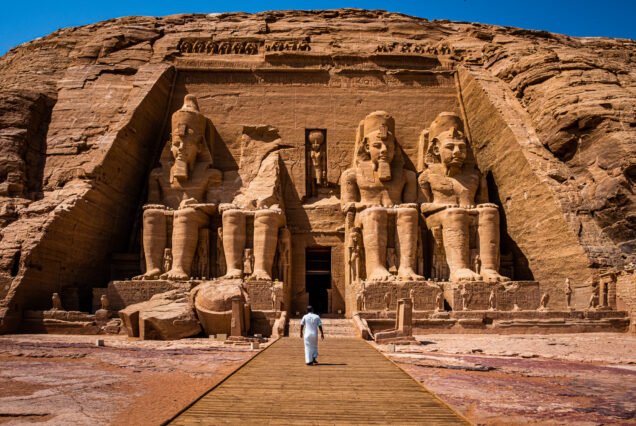
Arriving at Abu Simbel, your first sight of the temples carved directly into the
mountainside is unforgettable. Four colossal seated figures of Ramses II, each over
65 feet tall, guard the entrance to the main temple. Their serene expressions and
perfect proportions demonstrate the artistic mastery of ancient Egyptian sculptors.
Look closely to see the graffiti left by 19th-century European travelers who
"rediscovered" the site after it had been nearly forgotten and partially buried by
desert sands.
Like Philae, the Abu Simbel temples were rescued from the rising waters of Lake
Nasser in the 1960s. In what is considered one of the greatest archaeological
engineering feats in history, the entire mountain facade was carefully cut into blocks,
moved to higher ground, and reassembled with such precision that twice a year, on
February 22 and October 22, the sun still penetrates the entire length of the temple
to illuminate the statues in the innermost sanctuary – just as the original builders
intended.
Inside the main temple, eight massive columns in the form of Osiris (the god of the
afterlife) support the ceiling of the first hall. The walls are covered with reliefs
showing Ramses II's military victories, particularly his famous battle against the
Hittites at Kadesh. Though the historical reality was likely a stalemate, these carvings
present it as a glorious Egyptian triumph – perhaps history's first example of
propaganda on a monumental scale.
Adjacent to the main temple stands the smaller but equally beautiful Temple of
Hathor, dedicated to Queen Nefertari, Ramses II's favorite wife. The facade features
six statues – four of Ramses II and two of Nefertari – an unusual honor indicating her
elevated status, as Egyptian queens were rarely depicted the same size as pharaohs.
The interior reliefs show Nefertari participating in religious rituals, often in the
presence of Hathor, goddess of love and music, who is typically depicted with cow's
ears or horns.
After thoroughly exploring both temples, you'll return to Aswan for lunch before
catching an afternoon flight to Hurghada on the Red Sea coast. The contrast between
the desert landscapes you've been experiencing and the azure waters of the Red Sea
creates a perfect transition to the relaxation portion of your journey.
Upon arrival in Hurghada, transfer to your beachfront resort in Sahl Hasheesh or
Makadi Bay. The remainder of the day is at leisure to enjoy the resort facilities –
perhaps unwinding with a swim in the sea or pool, or indulging in a spa treatment to
refresh after your temple explorations.
Dinner at the resort might feature fresh seafood caught that day in the Red Sea –
perhaps grilled red snapper or sea bass served with tahini sauce and accompanied
by a mezze selection of small dishes like baba ghanoush (roasted eggplant dip),
tabbouleh (parsley and bulgur salad), and muhammara (red pepper and walnut
spread).
Travel Tip: Abu Simbel can get extremely hot, especially in summer months. Wear
light, breathable clothing, bring plenty of water, and don't forget sun protection.
Photography is permitted inside the temples (unlike in the Valley of the Kings), so
make sure your camera batteries are charged. If you're interested in the twice-
yearly solar phenomenon, book well in advance as these dates attract large
crowds.
These three days offer a perfect balance of relaxation and adventure on Egypt's
stunning Red Sea coast. Hurghada, once a simple fishing village, has transformed
into a premier resort destination while retaining much of its authentic charm.
After the cultural intensity of your temple and tomb visits, today is dedicated to the
natural wonders of the Red Sea. Following breakfast at your resort, board a
comfortable boat for a full-day snorkeling excursion to Giftun Island National Park.
The contrast between the desert island's arid landscape and the vibrant coral
gardens surrounding it couldn't be more striking.
Your first snorkeling stop reveals an underwater world of astonishing beauty and
biodiversity. The Red Sea boasts some of the world's most pristine coral reefs, home
to over 1,200 species of fish, including the brilliantly colored parrotfish, the
distinctive black-and-white striped angelfish, and the graceful lionfish with its fan-like
fins. Even if you've never snorkeled before, guides are on hand to provide instruction
and ensure your safety.
Between snorkeling sessions, enjoy a delicious lunch aboard the boat – typically
grilled fish or chicken with rice and salads. The boat will likely stop at Orange Bay, a
stunning white sand beach extending into turquoise waters that seems almost
Caribbean in its beauty. Here you can relax on the beach, swim in the crystal-clear
shallows, or simply soak up the Egyptian sunshine.
For certified divers, optional diving excursions can be arranged to legendary sites like
Carless Reef or the Thistlegorm wreck – a WWII British merchant navy ship sunk in
1941 that now forms an artificial reef complete with cargo of motorcycles, trucks,
and ammunition.
Return to your resort in the late afternoon to freshen up before dinner. This evening,
consider trying one of Hurghada's seafood restaurants along the marina, where you
can select your fish from the day's catch to be prepared according to your preference
– grilled with olive oil and lemon, fried with spicy sauce, or baked with herbs and
vegetables in the Egyptian style.
Today offers a complete contrast to yesterday's marine activities as you venture into
the Eastern Desert for a thrilling safari experience. After breakfast, four-wheel-drive
vehicles will take you away from the coastal resorts into a landscape of stark beauty
– golden sand dunes, rugged mountains, and vast open spaces that have remained
largely unchanged for millennia.
The adventure begins with quad biking across the desert terrain – an exhilarating
experience as you navigate the undulating sands (no previous experience necessary;
full instruction provided). The sensation of freedom as you race across this ancient
landscape creates memories that will last a lifetime.
As the afternoon progresses, you'll visit a Bedouin camp where these desert nomads
maintain their traditional lifestyle despite the modern world encroaching. Here, you'll
be welcomed with sweet tea infused with mint or sage, served in small glass cups
according to Bedouin custom. Your hosts will demonstrate traditional bread-making
in the sand, and you might try riding a camel – the desert's traditional
transportation.
A Bedouin guide might show you how they locate water in this seemingly barren
environment and explain the medicinal uses of desert plants. You'll gain insight into
a way of life that has adapted perfectly to one of Earth's most challenging habitats.
As sunset approaches, the desert is transformed by the changing light – the sand
glows with hues of gold, amber, and finally deep rose. This magical moment is
followed by a traditional Bedouin dinner under the stars. Seated on colorful carpets,
you'll enjoy a feast of tender lamb, chicken, or kofta cooked over an open fire,
accompanied by rice, fresh salads, and warm flatbread.
After dinner, Bedouin musicians might perform folk songs on traditional instruments
as the night sky reveals a spectacular canopy of stars, unpolluted by city lights. Many
visitors report that this desert night, with its profound silence broken only by gentle
music and the crackling fire, becomes a highlight of their Egyptian journey.
Return to your resort late in the evening, perhaps stopping en route to admire the
resort area's twinkling lights from a desert viewpoint.
Your final day in Hurghada is left open for relaxation or optional activities according
to your interests. After the adventures of the preceding days, you might choose to
simply enjoy your resort's amenities – lounging by the pool with a good book,
swimming in the clear waters of the Red Sea, or indulging in spa treatments like a
traditional hammam (Turkish bath) experience or a massage using aromatic oils.
For those still craving activity, options abound: - Glass-bottom boat trips offer a way
to view the coral reefs without getting wet - Windsurfing or kitesurfing lessons take
advantage of Hurghada's perfect conditions for these exhilarating water sports -
Fishing excursions target the Red Sea's abundant marine life, including barracuda,
grouper, and tuna - Shopping in Hurghada's old town (El Dahar) provides
opportunities to purchase souvenirs in a more authentic setting than the tourist
bazaars
In the evening, enjoy a farewell dinner at your resort's finest restaurant. Many
upscale resorts in the area offer Egyptian-international fusion cuisine that might
include creative dishes like sea bass with dukkah crust, camel tenderloin with date
sauce, or traditional koshari reimagined with gourmet ingredients. Toast your Red
Sea adventures with Egyptian wine – perhaps a Jardin du Nil white or a Omar
Khayyam red – both surprisingly good despite not being well-known internationally.
Travel Tip: The sun in Hurghada is intense year-round. Even on cloudy days, use
high SPF sunscreen, particularly when snorkeling as water magnifies the sun's
effects. For desert excursions, a scarf that can cover your head and neck Bedouin-
style provides excellent protection. When shopping in Hurghada's markets, prices
are generally lower than in Cairo or Luxor, but bargaining is still expected.
After a final breakfast overlooking the Red Sea, you'll catch a morning flight back to
Cairo. The aerial view provides a striking illustration of Egypt's geography – the
narrow green ribbon of the Nile Valley suddenly giving way to endless desert,
demonstrating why this ancient civilization described their country as "the black
land" (fertile Nile Valley) surrounded by "the red land" (desert).
Upon arrival in Cairo, your guide will meet you for a day trip to Saqqara and
Dahshur – sites that showcase the evolution of pyramid building. Located about 30
kilometers south of Cairo, these necropolis areas served the ancient capital of
Memphis.
Your first stop is Saqqara, dominated by the Step Pyramid of Djoser – the world's
oldest major stone structure, designed by the genius architect Imhotep around 2630
BCE. This revolutionary building marked the transition from earlier mud-brick
mastaba tombs to true pyramids. Walking around this 4,700-year-old structure,
you're witnessing the birth of monumental stone architecture.
The Saqqara complex also includes the Pyramid of Teti, which you can enter to see
some of the earliest pyramid texts – religious spells carved into the walls to help the
king's journey to the afterlife. Nearby, the Mastaba of Ti contains some of Egypt's
finest Old Kingdom reliefs, showing detailed scenes of daily life including fishing,
farming, and even pet monkeys and wildcats.
A short drive brings you to Dahshur, where you'll see the Bent Pyramid and the Red
Pyramid – both built during the reign of Pharaoh Sneferu (2613-2589 BCE). The Bent
Pyramid gets its name from its unusual shape – the lower portion rises at a steep 54-
degree angle, then abruptly shifts to a gentler 43-degree slope. This design flaw
taught ancient architects valuable lessons about structural stability.
Nearby stands the Red Pyramid (named for the rusty hue of its limestone blocks),
which incorporated these lessons to become Egypt's first successfully completed true
pyramid. Less visited than the Giza pyramids, Dahshur offers a more peaceful
experience where you can often enter the Red Pyramid with few other tourists
present. The descent down the narrow passage requires some effort, but the
experience of standing in the ancient burial chamber, with its distinctive corbelled
ceiling, creates a profound connection to Egypt's distant past.
After lunch at a local restaurant, perhaps trying traditional stuffed pigeon (hamam
mahshi) – considered a delicacy in Egypt – you'll return to Cairo for a final cultural
experience at Al-Azhar Park. Created on what was once a debris dump, this 74-acre
green space has transformed a neglected area into one of Cairo's most beautiful
locations.
The park's design draws on Islamic garden traditions with fountains, geometric
layouts, and fragrant plants. From its hilltop location, you'll enjoy spectacular
panoramic views of historic Cairo, with hundreds of minarets punctuating the skyline.
As the afternoon light turns golden, this vista helps you appreciate why Cairo is
called "the city of a thousand minarets."
Within the park, the Citadel View Restaurant offers excellent Egyptian cuisine in an
elegant setting with views of the Muhammad Ali Mosque. Consider trying fattah – a
layered dish of rice, crispy bread, and lamb in vinegar-garlic sauce that dates back to
ancient times – or the more modern but delicious molokheya with rabbit, a green
soup with a distinctive texture served over aromatic rice.
After dinner, return to your hotel to prepare for tomorrow's departure. If you're
staying near Khan el-Khalili, you might enjoy a final evening stroll through the
illuminated streets, perhaps stopping at the historic El Fishawy Café – continuously
operating since 1773 – for a farewell glass of mint tea or Turkish coffee.
Travel Tip: If you're flying out the next day, this is a good time to confirm your
airport transfer and check flight status. For last-minute souvenirs, Khan el-Khalili
offers extended evening hours, but for fixed-price shopping without bargaining,
consider the government-operated Papyrus Institute or the Khan Misr Touloun
shop in Zamalek, both offering quality handicrafts at set prices.
Depending on your departure time, your final morning in Egypt might offer an
opportunity for last-minute shopping or relaxation. If you haven't yet visited Khan el-
Khalili bazaar, a quick trip could secure those final souvenirs – perhaps a cartouche
pendant with your name in hieroglyphics, a hand-crafted shisha pipe, or alabaster
candle holders that glow beautifully when lit.
For those interested in high-quality Egyptian cotton textiles, the Cotton House in
Zamalek offers excellent bed linens, towels, and clothing without the hassle of
bargaining. Nearby, the Loft Gallery showcases contemporary Egyptian art for those
seeking a more unique memento of their journey.
As your driver transfers you to Cairo International Airport, take a final look at this
fascinating city where ancient and modern exist in such close proximity – where you
might see a farmer leading his donkey past a luxury high-rise, or a businessman in a
suit pausing to pray beside a street vendor. These contrasts define Egypt, a country
simultaneously anchored in its glorious past and moving toward its future.
At the airport, your tour representative will assist with check-in procedures and any
last-minute questions. As your plane lifts off, carrying you away from the land of
pharaohs, you'll take with you not just photographs and souvenirs, but a deeper
understanding of one of humanity's greatest civilizations and the modern nation that
has grown from these ancient roots.
The memories of standing before the Great Pyramid, sailing the timeless Nile,
descending into royal tombs, and connecting with Egypt's welcoming people will
remain with you long after your return home – perhaps even inspiring a future return
to explore more of this endlessly fascinating country.
Travel Tip: Egypt observes a departure tax that is usually included in your ticket
price, but it's worth confirming this with your airline. Keep some small Egyptian
pounds for any final airport purchases or tips. If you've purchased antiquity
replicas, make sure they have a receipt and stamp from the shop, as genuine
antiquities cannot be exported from Egypt.


Reviews
There are no reviews yet.